THE ECOSYSTEM OF DRUG TRAFFICKING IN AFRICA (1st part)
- maagnyetakodjo
- May 13, 2022
- 2 min read
Drug trafficking on the African continent is evolving rapidly. Nevertheless, it retains two major trends because, despite the constantly increasing production and consumption, Africa remains mainly a transit area for the European and Russian markets.
The African drug's production and consumption
Regarding drug use, the UNODC 2020 report is clear. Between 2010 and 2017, the increase in cannabis use was the highest in Africa. For example, it is estimated that 1.2% of the Kenyan population and 10.8% of the Nigerian population use cannabis.
The number of opioid consumers in Africa increased to 6 million in 2017, up from 2.2 million in 2016. Non-medical opioid use is particularly high in West and Central Africa, where it is estimated to affect 1.9% of the adult population.
Non-medical usage of pharmaceutical opioids, particularly tramadol, has been expanding, with an increasing number of people initiating treatment for disorders induced by tramadol abuse [i]. The prevalence of non-medical utilization of pharmaceutical opioids has exploded at alarming rates in West Africa, with data on seizures being just the tip of the iceberg.
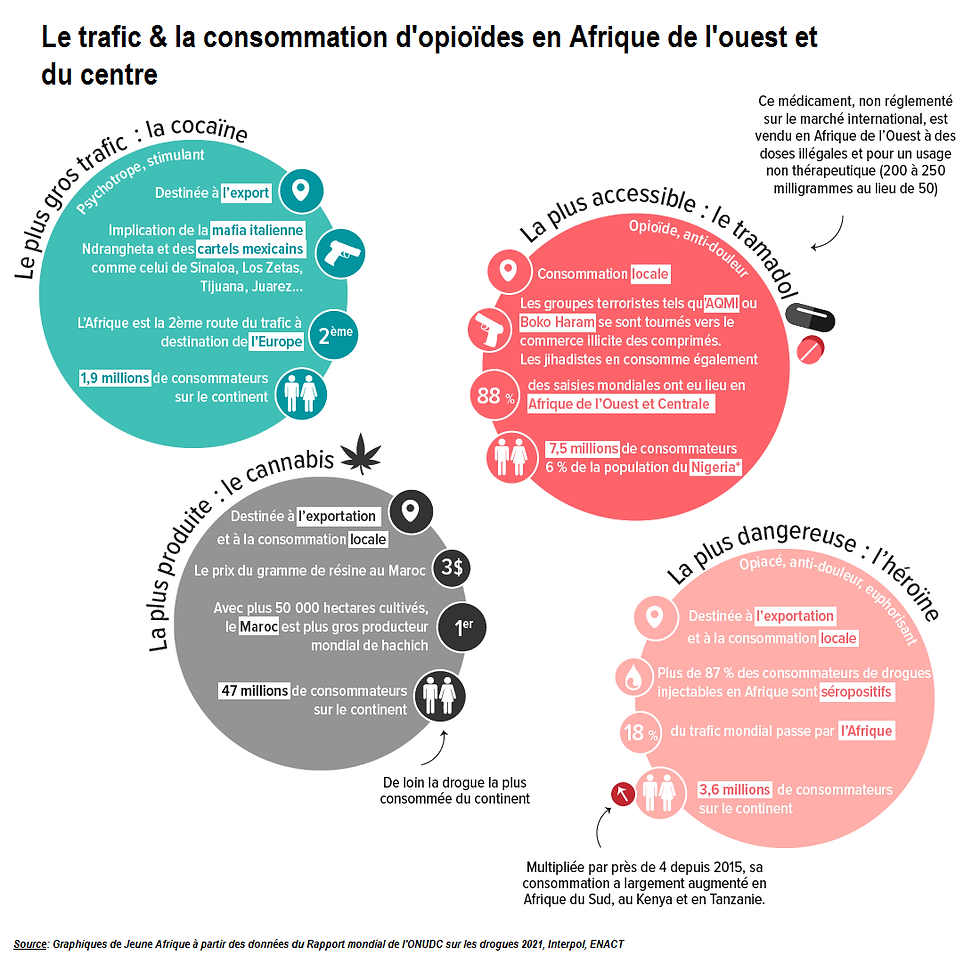
According to official records, overall tramadol seizures in West Africa were equivalent to 88% of all tramadol seizures in Africa and 77% of all tramadol sequestrations globally in 2017. Tramadol also accounted for 82% of all pharmaceutical opioids confiscated in West Africa in 2016 and 91% in 2017 [ii].
Although it is still minor, drug production has developed particularly in South Africa, already the main African consumer of synthetic drugs, given its history: the Apartheid regime had developed synthetic drugs in its covert chemical warfare program. The reduction of synthetic drug production in India accelerated the development of synthetic drug production in South Africa, mainly methamphetamine and methaqualone (commonly known as Mandrax®). Twenty-eight clandestine laboratories were dismantled in 2004. The number of ecstasy seizures increased by 85% between 2003 and 2004. Smaller labs were discovered in Kenya and Tanzania [iii].

Reliable data on cannabis production are sorely lacking throughout the continent. The areas devoted to the cultivation of this opiate are largely underestimated, the production in tons largely underestimated or unknown. This makes it hazarduous to establish real figures on local production and consumption of this opiate.
However, in the UNODC "Cannabis cultivation, production and eradication, latest year available from the period 2013-2019[iv]", which lists globally the areas devoted (ha) to cannabis cultivation, the production in tons, the areas devoted to cannabis cultivation that have been destroyed, a dozen African countries are listed with two standing out : Morocco with in 2018, 47,000 ha devoted to cannabis cultivation and a production (herbs, resin and plants included) of 24,123.38 tons; and Sudan with surfaces estimated at 7,744 ha and a production (herbs) of 774,400 tons.
While figures on drug production and consumption in Africa are growing with the years, the majority of drugs transiting the continent from Latin America and Asia are destined for the European market.
Maagnyeta Kodjo
Analyst, communication & project manager
[iii] Petereit Emilie, Poudre blanche et continent noir. La carte du trafic international de drogue se redessine, Multitudes, 2011/1 (n° 44), p. 103-106. DOI : 10.3917/mult.044.0103. URL : https://www.cairn.info/revue-multitudes-2011-1-page-103.htm
[iv] UNODC, Cannabis cultivation, production and eradication, latest year available from the period 2013-2019. https://www.unodc.org/documents/data-and-analysis/WDR2021/6.3.1_Cannabis_cultivation_production_and_eradication.xls
Comments